Showing posts with label Distributive Justice. Show all posts
Monday, October 11, 2010
Distributive Justice, Bargaining Theory and Morality (Index)
This is an index for my recent posts on bargaining theory, distributive justice and morality. I list them here in order in which I wrote them. Since I didn't originally intend for this to be a series, they may have a somewhat disjointed feel.
Index
1. Principles of Distributive Justice
2. The Nash Bargaining Solution
3. Egalitarian and Utilitarian Social Contracts
4. Axiomatic Bargaining, Moral Constructivism and Infant Mortality
Sunday, October 10, 2010
Axiomatic Bargaining, Moral Constructivism and Infant Mortality
In some recent posts, I have looked at the role that bargaining theory can play in our understanding of distributive justice. In this post, I want to summarise the earlier discussion and connect it with some broader points in moral philosophy. I also want to consider an example of a moral use of bargaining theory.
1. The Bargaining Problem Redux
To start things off, let's consider once more the basic bargaining game I outlined earlier. It was called "Divide the Money". In it, two players, A and B, are given a sum of money (say, $100) to divide between them. The rules of the game stipulate that both must demand a fraction of the money simultaneously. If the sum of those fractions is 1 or less than 1, the money is divided accordingly; if it is greater than 1, neither gets anything.
This is an example of a game in which the players can achieve some surplus by coordinating their behaviour on a set of strategies (in this case a pair of fractional demands) that allows them to share the money. These kinds of games are commonplace in social settings. Indeed, one could argue that society originated from our need to solve these distributive games.
Following the standard methods of game theory, when trying to solve this game we should look for the pair of strategies that is in equilibrium. The problem is that there are multiple possible equilibria in this game. Indeed, any pair of fractional demands that adds up to one is a potential equilibrium.
This presents us with a problem, despite the importance of these kinds of distributive games to society, we cannot find a unique solution to them.
2. The Axiomatic Approach
This is where bargaining theory steps in. It tries to use the basic analytical tools from game theory and decision theory to find unique solutions to bargaining problems. In an earlier post, we considered the axiomatic and cooperative approach to bargaining pioneered by John Nash. This cooperative approach assumes that once a bargain has been struck it is possible for the parties to implement it through joint action. It also works from a set of axioms, which are nothing more than assumptions about the behaviour of rational actors.
(Note: the non-cooperative approach has not been considered. I may do this at a later date, but don't hold your breath.)
We considered Nash's own bargaining solution in some detail. While it clearly succeeds in finding a unique solution to the bargaining problem, it does so with several questionable axioms in tow. In particular, Nash's assumption that removing irrelevant options would not change the behaviour of the players seems to be false. At best, this assumption could be adopted as a conventional constraint on the agreement by the parties. But if this is allowed, other conventional constraints could be adopted (in the form of axioms) which could lead to different solutions.
3. Moral Constructivism and Bargaining Theory
One reason that I have for being interested in bargaining theory is its potential for operationalising a type of moral constructivism, at least when it comes to distributive questions. I have an independent series of posts looking at moral constructivism. To briefly recap, moral constructivism is the view that moral truths are constructed, not discovered.
Two type of moral constructivism were discussed in that other series: (i) restricted constructivism and (ii) thoroughgoing (or metaethical) constructivism.
Restricted constructivism begins with a set of moral principles or intuitions that it then inputs into some mechanism. This mechanism, in turn, produces a set of moral judgments about a given area (e.g. distributive justice). This account is "restricted" in the sense that it does not provide a complete theory of the origin or nature of moral truths. It only provides a restricted account of the origin of moral truths in a given subject area. The moral inputs into the constructive mechanism could come from anywhere.
This is obviously in contrast to metaethical constructivism. This tries to provide a complete answer to all (or most) metaethical questions concerning the origin and nature of moral truths. It does so by trying to provide a formal account of practical reason and showing how moral judgments follow from this formal account. I have recently begun a series looking at one form of metaethical constructivism: Alan Gewirth's argument to the principle of generic consistency.
My feeling is that the axiomatic approach to bargaining provides a good way of operationalising restricted constructivism: the axioms are equivalent to the moral inputs and the formalisms of bargaining theory are equivalent to the constructive mechanism. The combination of the two produces a solution which is equivalent to a moral judgment.
I actually considered how this could be done in the previous post on utilitarian and egalitarian bargaining solutions. That post showed how John Rawls' device of the "Original Position" could be incorporated into a Nash-style bargaining solution.
If the axiomatic approach is to constitute a form of restricted constructivism, it is important that the axioms do reflect or cash-out certain moral intuitions. I want to consider one more (quick) example of this from the work of John Roemer.
4. Solving the Problem of Infant Mortality
Roemer asks us to imagine a charitable agency who deal specifically with the problem of child mortality in the developing world. The agency receives donations and it must decide how to spend those donations. Thus it is charged with solving a distributive problem.
Suppose it can spend its money on two types of intervention (x, y) that help reduce infant mortality. And suppose also that there are five countries (A - E) in which these interventions can be distributed. Country A has an infant mortality rate of 10%, Country B 8%, Country C 6%, Country D 4% and Country E 2%.
Roemer suggests that the following axioms apply to the agency's decision:
- (1) The ultimate distribution should be efficient in the technical sense that there is no way of reallocating resources so as to raise infant survival rates in one country without lowering them in another.
- (2) The distribution should be fair in two senses: (a) it is monotonic (any increase in the agency's resources should not lead to lower survival rates in any one country) and (b) it is symmetric (if countries have equal resources and technologies for deploying the intervention techniques, then the agency's distribution to these countries should be in proportion to their populations).
- (3) The distribution should be neutral in that it should not take into account any information that is irrelevant to infant survival.
- (4) The distribution should be consistent in that it should allocate the interventions (x, y) between the countries according to some consistent rule.
- (5) The distribution should be sensitive to the budget, technology-levels and resource base of the countries and the agency.
Roemer argues that these axioms embody an (eclectic) set of moral intuitions that we have about procedural and distributive justice. Furthermore he argues that only one distributive solution can satisfy all five conditions at the same time. This is the "leximin solution" which allocates resources in the following way:
First, reduce the infant mortality rate of Country A to that of Country B. Then, if there are resources left, allocate resources between A and B so as to reduce their infant mortality rates to that of C. And so on, until the budget has been exhausted.
5. Conclusion
As mentioned above, I think the axiomatic approach is one plausible way to operationalise restricted constructivism. More may need to be said about the types of moral issues or problems to which it can be properly applied, however, I will not be saying this for the time being.
The question I want to consider next is whether there is any plausible way of using the axiomatic approach to operationalise a metaethical form of constructivism. One person who has attempted to do just this is David Gauthier. I propose to look at his most famous work, Morals by Agreement, in a later series.
Friday, October 8, 2010
Egalitarian and Utilitarian Social Contracts
What originally began as one post on the various principles of distributive justice has quickly morphed into a series on bargaining theory and the social contract. In a previous post, I tried to explain Nash's bargaining solution.
In this post, the Nash bargaining solution will be used as the basis for understanding the difference between egalitarian and utilitarian social contracts. The discussion is based on Chapter 2 of Ken Binmore's Natural Justice.
1. The Social Contract and The Meeting Game
Societies are frequently called upon to solve coordination problems. These are bargaining problems where people need to coordinate their behaviour in order to achieve some mutually advantageous result.
I always refer back to Thomas Hobbes to explain this concept. Hobbes argued that in a "state of nature" (i.e. a state without a social contract) humanity would be trapped in an unending cycle of violence ("the war of all against all"). This could only be avoided if each individual gave up certain rights and agreed to create a strong central authority with a monopoly on violence (the Leviathan). Hobbes was thus arguing that there is a mutually advantageous result (avoiding the unending cycle of violence) that can only be achieved through coordinated behaviour. Achieving the necessary coordination is the purpose of a social contract.
The key moral question arising from this is the following: if there are gains to be made from coordinated behaviour, how are those gains to be distributed among the parties to the agreement?
We can use a very simple example of a coordination problem to explore the possible answers to that distributive question. The example is the Meeting Game:
Alice and Bob, who met through an online dating agency, have agreed to meet each other for the first time. They have ten possible locations at which they could meet. Although they are both eager for the meet-up, they have differing views on the most desirable location (this could be due to transportation, desire for publicity, ease of "bail out" etc.). Indeed, two locations are so undesirable to at least one of the players that they would rather not meet at all than meet there. Alice and Bob need to agree upon some meeting point.
The table below represents their respective payoffs for the different locations as well as the status quo payoffs (i.e. what the parties get if they don't agree to some meeting point).
It should be obvious from this that Alice would prefer not to meet than to meet at location 1; ditto for Bob at location 10. All other locations are on the negotiation table as they would lead to at least some gain over the status quo. To fit this in with our discussion of the social contract, we can think of the status quo as being equivalent to the state of nature.
The meeting game can also be represented geometrically, as in the following diagram (see this post for more on what such a representation is intended to show).
The blue curve with the ten marked points represent the ten solutions to the game (corresponding with those in the table). The point D represents the status quo or state of nature. If we assume the parties have equal bargaining power, we can easily locate the Nash bargaining solution. It occurs at the point N, which is where the product of gains over the status quo is highest,
- (34 - 4) x (22 - 2) = 600
This is higher than any of the nearest rivals. For example, at points 6 and 8, the product of gains over the status quo is,
- (28 - 4) x (26 - 2) = 576
- (40 - 4) x (18 - 2) = 576
If you are wondering how equality of bargaining power can be incorporated into the Nash bargaining solution, I invite you to consider the equations that were formulated in the previous post. Look at the variables h and k in those equations. These can be thought to represent the bargaining power of the parties. If we set h = 1/2 and k = 1/2, we can model the equality of bargaining power.
2. Adding some moral content: The Original Position
The Nash solution outlined above has no moral content. It says that a certain solution to the coordination will be reached under a particular set of assumptions. But it does not say whether that solution is fair or morally good.
The amorality of the solution is apparent once you realise (according to Nash's assumptions) that if the scales used to measure each player's utility are recalibrated, the solution remains the same. So for example, if we change Alice's payoff scale so that each unit is now worth twice what it used to be worth, the solution is still the same even though she now gets double the satisfaction. This would strike many as being deeply unfair since it fails to take into consideration how the benefits of coordination are distributed. But under Nash's theory it can't be otherwise, as Binmore puts it:
Players can't alter their bargaining power by changing the scale they choose to measure their utility, any more than a physicist can change how warm a room is by switching from degrees Celsius to degrees Fahrenheit.There are ways to add some moral content to the Nash solution. Binmore considers one such way: using the device of the original position. The original position, as many know, comes from the work of John Rawls. Rawls argued that, in order to assess the justice of a given distribution of social goods, we have to ask whether we would agree to that distribution if we were bargaining from behind a veil of ignorance. This is the "original position".
The veil of ignorance prevents us from knowing where we will end up in society. In the example of the meeting game, this would mean that Alice and Bob have to negotiate their agreement without knowing which one is Alice and which one is Bob. In other words, with the possibility that their identities are randomly reassigned after the agreement is reached. As a result, whatever agreement each proposes will need to keep in mind both sets of payoffs.
The original position allows for complete impartiality when negotiating over possible schemes of distribution. If one thinks that impartiality is morally desirable, it constitutes the addition of a moral component to our understanding of the Nash bargaining solution (and the social contract).
3. The Need for Social Indices
In order for the original position to play a meaningful role in how we think about coordination problems such as the Meeting Game, there must be some way to compare the utility functions of different individuals (i.e. to allow for interpersonal comparison). This is what makes it legitimate to think about the reassignment of identities after the agreement.
Unfortunately, the standard method for deriving utility functions does not allow for such interpersonal comparison. This is because, as mentioned previously, the scales chosen for personal utility functions are arbitrary. We cannot say they are the same from person-to-person. The temperature analogy works again here: it would not be possible to compare temperature measurements across different locations if one did not know which temperature scale was being used. The same holds for utility functions.
Binmore argues that what we need is a "social index". This would allow us to say how much one of Alice's utils is worth in terms of Bob's utils, i.e. it would allow us to determine the ratio of Alice's utils to Bob's. The social index would represent society's total judgment on the relative worth of the two individuals. There could be a huge number of factors influencing such a judgment, but from a game theoretical perspective all that matters is the ratio.
(Note: John Harsanyi has an argument -- or a bit of "dogma" if you prefer -- which suggests that if the parties have access to the same information we can legitimately assume they have the same utility functions. Binmore thinks our capacity for empathy may allow for this. Make of it what you will.)
4. Utilitarian and Egalitarian Solution
Once we have a social index, we can proceed to consider the solution to the Meeting Game that would be reached in the original position. Even here things are uncertain, with two plausible candidates. To examine these, let's assume that the social index makes one of Bob's utils worth two of Alice's.
I. The Utilitarian Solution
A utilitarian would maintain that the best solution (given the veil of ignorance) is the one in which utility is maximised. In other words, the point at which the sum of the index-weighted payoffs is greatest. This occurs at location 3 in the Meeting Game because,
- (16/2) + (34/1) = 42
is greater than any of the alternatives e.g. location 4,
- (19/2) + (32/1) = 41 and 1/2
This solution is represented geometrically below.
The dotted line of slope - 1/2 moves down one unit for every two units it moves across (I didn't draw this precisely). This depicts the fact that one of Bob's utils is worth two of Alice's. The utilitarian solution occurs at the point where this line touches the boundary of the set of possible solutions.
II. The Egalitarian Solution
An egalitarian (like Rawls) would maintain that the best solution (given the veil of ignorance) is the one that gives each player an equal gain over the status quo.
Obviously, this gain over the status quo need to be weighted for each player in accordance with the ratio of utils. If the ratio was 1:1, the egalitarian solution would occur at location 6, because,
- (28 - 4)/1 = (26 - 2)/1
However, in the case where one of Bob's utils is worth two of Alice's, there is no single solution. This can be seen in the geometric representation given below.
The dotted-line of slope +1/2 through the point D represents the social index. This line only intersects the efficient boundary of the set of possible solutions at the point E, somewhere between location 7 and location 8. The best that Alice and Bob can do is to randomise between the two locations (maybe meeting at location 7 on weekdays and location 8 at weekends).
5. Some Conclusions
This post has shown three things. First, it has shown how the Nash bargaining solution can be used to understand the coordination problems that lie at the heart of the social contract. Second, it has shown how Rawls's device of the original position can be used to inject some moral content into the Nash solution. Third, it has outlined the differences between a utilitarian solution to a coordination problem and an egalitarian solution.
Before finishing up, it's worth noting two important differences between the utilitarian and egalitarian solutions:
- Utilitarian solutions do not care about the status quo (or "state of nature"). They think that how we got to the position we are now in is irrelevant to deciding where we should go next. Egalitarian solutions care greatly about the status quo, and evaluate all potential social changes by comparison with it.
- Utilitarians and egalitarians look at the social index in different ways. This is obvious from the two different geometrical representations. For a utilitarian, a decrease in someone's social index (i.e. an increasing of the worth of one of their utils in comparison with someone else's) increases their contribution to the weighted utilitarian sum. Thus a utilitarian favors giving more help to those with lower social indices. Conversely, for an egalitarian, a decrease in social index decreases the utility awarded by the egalitarian solution. Thus an egalitarian favours helping those with higher social indices.
I'll look at more issues arising from bargaining theory in later posts.
Thursday, October 7, 2010
The Nash Bargaining Solution
![]() |
1. Why the need for a Bargaining Solution?
Consider the following simple bargaining game:
Two players, A and B, are given 100 dollars to divide between them. According to the rules of the game, they must each make a demand for some fraction of the 100 dollars simultaneously. If the sum of their fractional demands is less than or equal to 1, the division will go ahead; if it is greater than one, the money is lost to both.If you were a player in this game, how much should you demand? 50 dollars? 75 dollars? 25 dollars? Or something else? Game theory tries to help us to answer those questions. It is the formal analysis of strategic interactions.
When trying to decide what to do, game theory offers some simple guiding principles. First off, if possible, you should try to play a strictly dominant strategy, i.e. a strategy that yields the best result for you no matter what the other player does. As it happens, the divide-the-money game does not have a strictly dominant strategy: if my opponent demands $50, I am best off if I demand the same. But if my opponent demands $75, I am not best off demanding $50, instead I should demand $25.
Alternatively, you should try to play the strategy that is the best response to some rationalisable strategy of your opponent. In other words, using some plausible assumptions about what I think my opponent will demand, I should play the strategy that would be the best response to that demand. So if I think my opponent will demand $50, I should demand $50; if I think my opponent will demand $25, I should demand $75; and so on.
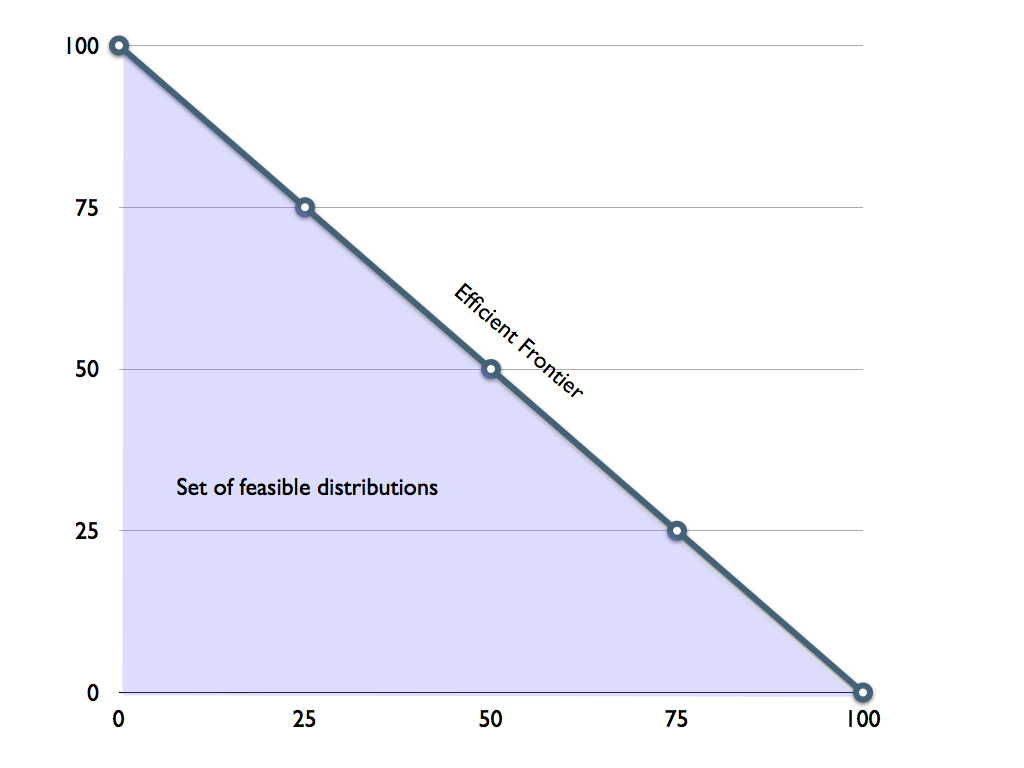
A game has a Nash Equilibrium whenever players can play best responses to each others' best responses. Under assumptions of rational choice theory, rational players are most likely to play a Nash equilibrium when it is possible to do so. The divide-the-money game has a large (potentially infinite) number of Nash equilibria. Indeed, every division of the money that adds up to exactly $100 would constitute a Nash equilibrium.
Think about it: my best response to my opponent's demanding $75 is to demand $25. At the same time, his best response to my demanding $25 is to demand $75. The same reasoning applies to every division in which the sum of our demands equals $100.
The image below depicts the potential solutions to the divide-the-money game. The blue shaded region represents the set of potential distributions (less than or equal to 100). The solid black curve represents the efficient frontier of the set of possible distributions. Every point along this efficient frontier is a potential Nash equilibrium.
The analysis so far is disappointing. The basic principles of game theory show that there is no unique solution to the bargaining game. This is where the Nash bargaining solution comes into play. It tries to show how, given certain assumptions, there can be a unique solution.
2. Nash's Bargaining Solution
To understand the Nash bargaining solution, we will look at a general model of a bargaining game as opposed to a specific numeric example. The math is fairly elementary. I take this version from here (without doubt the best serious introduction to game theory).
Again, there are two players, A and B, who seek to split some total value v, through some sort of negotiated agreement. If no agreement is reached, A will get a and B will get b. These figures represent the payoff that the players can achieve on their own, independent of a negotiation. Sometimes these are referred to as BATNAs (Best Alternatives to Negotiated Agreement).
In order for the negotiated agreement to be worthwhile, it must be the case that v is greater than the sum of the BATNAs. In other words: a+b < v. This means that there is a positive surplus (v - a - b) to be achieved from the negotiation.
In the final agreement, A will get fraction h of v and B will get fraction k of v. The sum of these fractions will equal one (h + k = 1). If x represents the total sum that A ends up with, and y represents the total sum that B ends up with, we can formulate the following equations:
- x = a + h(v - a - b), or x - a = h(v - a - b)
- y = b + k(v - a - b), or y - b = k(v - a - b)
These expressions are known as the Nash formulas. They just say that the positive surplus (v - a - b) is divided between the players in the proportions h:k:
- (y - b) / (x - a) = k / h
or in slope-intercept form:
- y = b + k/h(x - a) = (b - (ak/h)) + k/h(x)
This can be represented geometrically as follows.
In this diagram, P represents the disagreement point. It is what can be achieved independently of a negotiated agreement. All divisions of v in the proportions h:k lie along the straight line joining P and Q. The efficient frontier is represented by the thick green line joining (v, 0) and (0, v).
The Nash Bargaining solution is represented by the point Q (the intersection of the two lines). As can be seen, it is a unique point and hence constitutes a unique solution to the bargaining game. The coordinates of this point (r, s) are the parties' payoffs after the agreement.
3. Why this Solution?
To this point, nothing has been said about the credibility of the Nash bargaining solution. Indeed, the formulas cited above are agnostic about the mechanism through which the agreement is actually reached.
The credibility, such as it is, of the solution comes from certain assumptions (axioms) that Nash formulated about the bargaining process. First, Nash assumed that the bargaining game was cooperative as opposed to non-cooperative. These terms are used in a technical sense in game theory and, as is the case with most technical terms, they bear little resemblance to the mundane everyday use of those terms.
In particular, it is not the case that players in a non-cooperative game are unable to cooperate with one another. Nor is the case that players in a cooperative game are unable to be non-cooperative. Instead, a non-cooperative game is said to arise whenever players make their decisions and play their strategies without prior communication or agreement. A cooperative game arises whenever players can consult with another and plan joint action.
Game theorists generally think that non-cooperative games are more significant because the conditions necessary for cooperative games are rarely met. However, they may be met if there is some sort of enforcement mechanism that would ensure that the joint agreement was implemented.
Nash modeled bargaining as a cooperative, as opposed to a non-cooperative, game and this allowed him to reach his solution. (Note: there is an argument for thinking the same solution would apply in certain non-cooperative games. However, I'm not going to explain it here.)
In addition to this, Nash made several key assumptions about how the players would act. Before listing them, it should first be noted that the standard general assumption of decision theory is that actors have utility functions for payoffs, and that they seek to maximise their utility (I hope to cover the different forms of utility function at a later date). Nash's additional assumptions were as follows:
- Efficiency: The players will exploit the full value v. They will leave no portion of v undistributed.
- Independence of Irrelevant Alternatives (IIA): This means that if options that none of the players would have chosen are removed from the game, there is no change in outcome. Suppose, for example, player A has three offers they could make x, y and z. Suppose, further, that A thinks z would be best. Now, along comes a third party who removes offer x from A's pool of possible offers. According to IIA, nothing will change since A was never going to choose x anyway.
- Symmetry: If the players' utility functions for v are the same, they should each receive the same outcome.
- Independence of (Linear) Utility Rescaling: The utility functions for players can be calibrated or scaled in somewhat arbitrary ways. With this assumption, Nash is saying that if we recalibrate or rescale the utility function on a linear basis, we do not change the solution to the game. This is a good thing since utility functions are arbitrarily scaled. Note that this would not apply if the rescaling were non-linear. A non-linear scaling would imply that the player has changed their attitude towards risk and so would actually change their behaviour. To give an example, imagine a game with two possible payoffs: (i) $25 for sure; and (ii) $0 with 75% certainty and $100 with 25% certainty. The expected payoff from (i) and (ii) is the same (i.e. $25). However, a risk averse player would prefer (i) over (ii) and would, as a result, have a concave utility scale. By way of contrast, a risk-loving player would prefer (ii) over (i) and would have a convex utility scale.
Through these assumptions, Nash guarantees a unique solution to the bargaining game. The solution will lie along the efficient frontier of the set of feasible solutions, and will be the point at which the product of the the players' gains over the disagreement point is highest. In the example given above, this would imply that (r - a)(s - b) is higher than any other value along the line (v, 0) to (0, v).
To put it another way, it is the point at which the aggregate utility of the players is maximised. This solution is unsurprising given the economic basis of Nash's theory.
4. Do the Assumptions Hold Up?
Nash's assumptions are the key to his solution. Without them, he would not be able to find a unique solution to the bargaining game. So are they reasonable assumptions?
One of the more interesting findings from experimental economics is that IIA is almost certainly false. One might think that if A is preferred to B and B is preferred to C, the removal of C from the set of possible choices would make no difference. As it turns out, there are all sorts of weird effects that can arise when choices are added and removed. Dan Ariely's discussion of the Economist's subscription rates is instructive in this regard.
Although IIA is false, it might be possible for players to adopt it as a conventional constraint on their bargaining. But if we are going to do that, it might be possible for other conventions that yield different, but still unique, solutions to be adopted. Indeed, Kalai and Smorodinsky have done just that with their "monotonicity" axiom. This was used by David Gauthier in his book Morals by Agreement (well worth reading, if you get a chance). I'll be covering Gauthier's basic argument soon enough.
Nash's other assumptions seem more plausible. The other potentially problematic one is the symmetry assumption. For it to be true, different players would have to have identical utility functions. But one may wonder whether it is possible for such symmetry to really exist.
5. Conclusion
Despite these limitations, the Nash bargaining solution is still a noteworthy achievement. It shows that unique solutions to bargaining games such as those discussed above are not implausible.
One may ask: why am I interested in this? Well, the answer is that bargaining theories such as this can make important contributions to our understanding of social contracts. I'll look at those contributions in later entries.
Subscribe to:
Posts (Atom)