Naturally Select Away From This Evolution
The Strong Survive and This Game Perishes
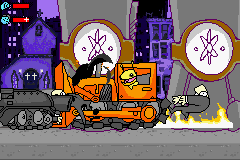
I'm not familiar with the 2001 film Evolution, but we have it to thank -or blame- for Alienators: Evolution Continues. Actually, Alienators is based on a short lived, animated, kids' TV show that was based on the movie, and we all know the quality of product that is churned out when a kids' show is adapted into a video game. In this case, though, Alienators is playable, and that's more than I could say for most games of this sort. The game puts you in control of Ira, a scientist/mercenary/soldier character who fills the typical hero role. The story is told in blocks of text between each of the levels, and it really doesn't matter all that much. The game could just as easily started with a message that read “There are monsters and stuff; go blow them up.” the game wouldn't have lost anything important and it would have gained style points, in my eyes, at least.
Gameplay is what you might expect: there's some shooting, there's some jumping, and there's a fair bit of collecting. As you progress through the game, you'll have to explore each of levels, collecting items as you go, before finally finding the exit and moving on. What can I say; it's a tried and true formula, and there's a reason why it's often used: it just works. There are times, though, when Alienators feels like it's a bit worn thin, especially when you stop and realize that other games have done the same things, only better. It may not be a fair comparison, but games like Mega Man ZX, Metroid: Zero Mission, and even Star Wars: Apprentice of the Force feel similar and superior to this game. Also, the controls feel loose to me, but that's a subjective gripe, so I won't dwell on it.
What is less subjective is the atrocity of the game's password feature. There is no save option in the game, if you want to put the game down for a while and then pick it back up later, you'll have to write down an eight digit password before you leave. Then, when you come back to the game, you'll have to input that password to return to your location. While it may sound like it wouldn't be a big deal, there's just no excuse for a Gameboy Advance game to not have a cartridge save feature. The only reason why a company would release a game without a save feature is to avoid having to put a battery in the cartridge, and therefore cutting the cost of each copy created. It's a penny pinching move that doesn't reflect well on the production values of the game. It wouldn't be so bad, it could even be overlooked, if the game allowed you to continue when you die, but as it is, you'll have to re-input the password every time you die: more often than you might think considering the fact that enemies respawn while health items do not.
While I might not call the graphics beautiful, I must say that I have a soft spot for sprites, and the game provides passable visuals. The enemies might not have the most original designs, but they're all good looking, and the backgrounds aren't bad either. The music is fine, if a little repetitive on the menus, but the music on the levels ranges from alright and repetitive to mind numbingly annoying and repetitive. Sound effects aren't anything to write home about: just about typical.
Come to think of it, if I were to use one word to describe this game, it would probably be “typical.” There's not a lot here that you haven't seen before in other, better games. I don't think there's anything here that needs to be played unless the Alienators TV show holds some sort of nostalgic appeal to you. If you want to prove me wrong, though, you won't have to break the bank to get your hands on a copy of the game. If you shop around a bit, you can find Alienators: Evolution Continues for around $5, but if you take my advice, you'll steer clear of this game.
--Tom
Showing posts with label Gameboy. Show all posts
Friday, December 31, 2010
Alienators: Evolution Continues - Review
Alien Hominid - Review
Short and Sweet
Intergalactic Crash Landing: Fun Ensues
Newgrounds is a website well known for games, but the games that populate its servers are typically of the flash variety, nothing like commercial products of any sort. It was, therefor, quite a surprise for me when I noticed the Newgrounds logo slapped onto the charming shooter for the Gameboy Advance, Alien Hominid. Had I been more familiar with the Alien Hominid brand, I would have known that the game debuted as a flash game that was featured on the aforementioned site and racked up over 19 million plays. The developers, an ironically small company known as The Behemoth, adapted and improved their successful flash game and released Alien Hominid for the Xbox, Playstation 2, and Gamecube in the latter part of 2004. Another small game developer, Tuna Technologies, was hired to port the game to the GBA, and the result is the game whose review you now happen to be reading.
Usually, I'm rather hard on commercially released sequels or adaptations of flash games, but in this case I think that the game was improved enough to warrant the cost. The game plays as what I'm tempted to call a “typical” side-scrolling shooter, but, really, there aren't enough games in this genre to dismiss the mechanics as typical. I should say that the control in Alien Hominid is very tight, reminiscent of games like Metal Slug or Gunstar Heroes. You should have no trouble maneuvering your little yellow alien through the game world, blowing the heads off of FBI agents and Soviet soldiers as you go. If there's one thing this game is not afraid to do, it's make a spectacle: clever boss battles range from giant sand monsters to an assortment of large robots, and copious amounts of blood burst from every grunt you take down. The gore can be turned off, but honestly: why would you? It might not quite fit the definition of epic, but it's certainly reaching toward that goal.
What may not be quite so epic is the game's story mode. Every once in a while, you'll watch a couple of still frames and get the general gist of what's going on, but the story really only exists to fit the segments together. Nuclear war, Area 51, Yeti, and, of course, Aliens are all crammed in to the mixture without a whole lot of explanation, but you probably won't need it either. In a title like this that is all about the gameplay, I found that the disparate elements that are introduced without ceremony, flow together to create a game that doesn't seem to be taking itself seriously. There are no moral quandaries to be considered in Alien Hominid, there is no time to stop and think about the wives and children of the endless waves of FBI agents that you'll be murdering, there is only nonstop action, and for that, I've got to commend the game.
What I can't commend the game for is its length. It took me less than two hours to see everything that Alien Hominid has to offer, and a playthrough of the main game itself will take less than an hour. Shelf life is somewhat extended by the inclusion of three minigames, but even these are a bit of a let-down. Coming off as little more than simplistic flash-esque games themselves, the minigames probably won't occupy you for very long. If you're going to reap continued enjoyment from this game, you'll have to be willing to put in multiple playthroughs, a possibility that is nicely enhanced by the well-implemented difficulty settings which do a good job of making the game accessible without compromising the rest of the game. You'll have to play on medium or hard if you want to see all of the levels the game has to offer.
The music is somewhat forgettable, and I could go on with nit-picky details like my hatred of the way you're forced to hide in level 3-1, or the awkward spaceship levels at the end of the first two worlds, but those are forgivable faults. The important thing is that the game is fun, and if you're willing to put up with the fact that there are only 12 levels, there's no real reason why you should pass this game up. The only difficulty might be the availability of the cartridge: the game was only released for the Gameboy Advance in Europe, so you might have to do some looking around before you're able to dig up a copy. Used copies do occasionally show up on Ebay and Amazon, though, and the prices are typically in the mid range of around $10. It may have its flaws, but if what I've said here doesn't sway you, feast your eyes on some gameplay footage and tell me what you think in the comment section below.
Alien Hominid Gameplay
More Alien Hominid Gameplay
--Tom
Intergalactic Crash Landing: Fun Ensues
Newgrounds is a website well known for games, but the games that populate its servers are typically of the flash variety, nothing like commercial products of any sort. It was, therefor, quite a surprise for me when I noticed the Newgrounds logo slapped onto the charming shooter for the Gameboy Advance, Alien Hominid. Had I been more familiar with the Alien Hominid brand, I would have known that the game debuted as a flash game that was featured on the aforementioned site and racked up over 19 million plays. The developers, an ironically small company known as The Behemoth, adapted and improved their successful flash game and released Alien Hominid for the Xbox, Playstation 2, and Gamecube in the latter part of 2004. Another small game developer, Tuna Technologies, was hired to port the game to the GBA, and the result is the game whose review you now happen to be reading.
Usually, I'm rather hard on commercially released sequels or adaptations of flash games, but in this case I think that the game was improved enough to warrant the cost. The game plays as what I'm tempted to call a “typical” side-scrolling shooter, but, really, there aren't enough games in this genre to dismiss the mechanics as typical. I should say that the control in Alien Hominid is very tight, reminiscent of games like Metal Slug or Gunstar Heroes. You should have no trouble maneuvering your little yellow alien through the game world, blowing the heads off of FBI agents and Soviet soldiers as you go. If there's one thing this game is not afraid to do, it's make a spectacle: clever boss battles range from giant sand monsters to an assortment of large robots, and copious amounts of blood burst from every grunt you take down. The gore can be turned off, but honestly: why would you? It might not quite fit the definition of epic, but it's certainly reaching toward that goal.
What may not be quite so epic is the game's story mode. Every once in a while, you'll watch a couple of still frames and get the general gist of what's going on, but the story really only exists to fit the segments together. Nuclear war, Area 51, Yeti, and, of course, Aliens are all crammed in to the mixture without a whole lot of explanation, but you probably won't need it either. In a title like this that is all about the gameplay, I found that the disparate elements that are introduced without ceremony, flow together to create a game that doesn't seem to be taking itself seriously. There are no moral quandaries to be considered in Alien Hominid, there is no time to stop and think about the wives and children of the endless waves of FBI agents that you'll be murdering, there is only nonstop action, and for that, I've got to commend the game.
What I can't commend the game for is its length. It took me less than two hours to see everything that Alien Hominid has to offer, and a playthrough of the main game itself will take less than an hour. Shelf life is somewhat extended by the inclusion of three minigames, but even these are a bit of a let-down. Coming off as little more than simplistic flash-esque games themselves, the minigames probably won't occupy you for very long. If you're going to reap continued enjoyment from this game, you'll have to be willing to put in multiple playthroughs, a possibility that is nicely enhanced by the well-implemented difficulty settings which do a good job of making the game accessible without compromising the rest of the game. You'll have to play on medium or hard if you want to see all of the levels the game has to offer.
The music is somewhat forgettable, and I could go on with nit-picky details like my hatred of the way you're forced to hide in level 3-1, or the awkward spaceship levels at the end of the first two worlds, but those are forgivable faults. The important thing is that the game is fun, and if you're willing to put up with the fact that there are only 12 levels, there's no real reason why you should pass this game up. The only difficulty might be the availability of the cartridge: the game was only released for the Gameboy Advance in Europe, so you might have to do some looking around before you're able to dig up a copy. Used copies do occasionally show up on Ebay and Amazon, though, and the prices are typically in the mid range of around $10. It may have its flaws, but if what I've said here doesn't sway you, feast your eyes on some gameplay footage and tell me what you think in the comment section below.
Alien Hominid Gameplay
More Alien Hominid Gameplay
--Tom
Saturday, December 18, 2010
Pac-Man Pinball Advance - Review
Pac-Man Plays Pinball
Not Quite Amazing
Few of the Arcade greats had easy transitions to modern gaming. The video game industry was forced to make a huge departure from the primarily coin-operated market of the late 70's and early 80's, moving to the home console-driven market of the late 80's to the present day. Some stars of the arcade days, like Donkey Kong, went into the new market almost seamlessly with high-profile games like Donkey Kong Country that established them in the modern era as viable mascots, and for a while there, it seemed like if anyone were to succeed, Namco's Pac-Man would. Pac-Man's enormous popularity allowed him to overcome missteps like Pac-Man on the 2600 or Pac-Man 2 on the SNES and Genesis, and the lovable yellow dot even managed to successfully cross over the 2D-3D divide in 1999's Pac-Man World. However, the last decade hasn't been very kind to Namco's hungry, hungry spheroid, and after a long parade of spin-off titles, Pac's reputation isn't quite what it used to be. While the recent Pac-Man Championship Edition DX has been receiving rave reviews, we're not talking about that game today. Instead, we've got one of those dreaded spin-offs: Pac-Man Pinball Advance.
I would like to think of myself as an open minded guy, and I was willing to enjoy Pac-Man pinball as nonthreatening, kid-friendly pinball game for the younger-skewing Gameboy Advance, but sometimes games don't even give you the chance to like them. The game starts off with a none-too-pretty cut-scene that seems to be comprised of low-resolution, 2D elements from Pac-Man World 2. The story is the same kidnapped family tale that was told in the first Pac-Man World, but, really, a story isn't necessary in a pinball game. The point of pinball is to play the game, and you'll be supplied with two different boards to do just that. Each board includes alternate a night version that is essentially a new skin of the same board with a blue color scheme.
As is so often my complaint with cheaply made pinball games, the physics of Pac-Man Pinball Advance just don't seem like they've been refined. The flippers aren't able to get the ball up to speed half the time and the speed of the ball doesn't seem to be correctly fitted to the rest of the gameplay. The boards, too, seem like they weren't well designed for the way the game is played, with many of the objectives purely luck based and deadly gutters that are diabolically placed in a such a way that you're only ever a couple of bumpers away from loosing. These factors add up to make the game seem like it's less about the core skills of pinball and more about just hitting the ball around and hoping that something will happen.
I can speak positively about the music, though. Taking inspiration from the sound-tracks of the first two Pac-Man World games, the music is suitable different but comfortably similar to what we've heard before, never overstated, but not noticeably enjoyable either. It is, to some extent, just there, but it's not bad. The game also has some nice features like multi-ball, functional store system, and he nice touch of a ghost eating mode, but these are outweighed by the almost unforgivable lack of a high-score table.
I don't think there are any hard-core Pac-Man fans to whom I can recommend this game, but if there are, I have to wonder how they explain the last ten years of Namco trying to use Pac-Man as a cash cow for mediocre games like this one. The game can be found for five to ten dollars, but I can think of no good reason why you need to search out a copy. If you find yourself feeling the need for a power-pellet or two, stick with the classics, there's no need to turn to Pac-Man Pinball Advance.
Wednesday, December 15, 2010
Pinball of the Dead - Review
Zombies Prefer Pinball of the Dead
BRAAAAAAAAAAAAINS!
House of the Dead is probably one of the most venerated on-rail shooter series ever to bless us with its presence. Chances are, if you go to your local bowling alley or pizza parlor, there will be a House of the Dead arcade cabinet around the corner. When you've got a franchise like this, there's always the temptation to throw together a spin-off title and see how well it does. These can range from awesome, as is the case with Typing of the Dead, a re-make of the original House of the Dead where keyboarding skills take precedent over itchy trigger fingers, to meh, as is the case with Pinball of the Dead for the Gameboy Advance.
In Pinball of the Dead, you'll be playing through the events of one of the House of the Dead games. Don't ask me which one, though, because, honestly, do you need a story for a zombie pinball game? The game consists of fairly typical pinball action with the addition of flesh-eating monsters are various other unpleasantries. You'll rack up points in a fairly typical way over the course of three boards: Wondering, Movement, and Cemetery. The boards are all multi-level and fully functional, but they're not all created equal, Wondering lacks color or variety, and Movement gets old quickly. Of the three, I prefer Cemetery simply because of how populated the board seems with bumpers, switches, and lights. It looks better and seems to be more enjoyable.
Pinball is one of those genres that's surprisingly hard to pull off: if you've ever played pinball in real life, you know what pinball “feels” like. When games don't get the physics right, it's very easy to notice. Unfortunately for Pinball of the Dead, the developers didn't quite get things right. There are tw speed settings for the ball, but even the fast option leaves the ball moving at a snail's pace, but even that can be inconsistent, with the ball suddenly speeding up or slowing down for no reason. The hit detection seems to be a little off on the flippers, too, as sometimes the ball will fly off in the opposite direction. In general, the physics just aren't right, and in a game that relies on predicting where something will go, you need to have consistency.
The game isn't all that pretty to look at, either. Keeping in mind the age of the game and the platform for which it was released, it's still not a beautiful game. The graphics aren't terrible, but they're undefined in the way of that awkward transition between all 2-D and 3-D capable consoles. The music isn't anything special, and the sound effects are similarly unexciting. The voice acting is fairly well done and not overused. It actually seemed like the sort of one liners that might be delivered from the speakers of a pinball table. A saving grace, if only a small one.
By this point, you might be thinking that I'm going to conclude by trashing the game and saying that you should probably purchase something else if you want to get a pinball fix, and while this may be true, don't dismiss Pinball of the Dead out of hand. This is the sort of game that grows on you -or perhaps more aptly, creeps up on you- and when you start to get into it, it's not all that bad. I found the whole to be greater than the sum of its parts, but that might not be the case for you. I would be lying if I said there aren't better pinball games on the Gameboy Advance, but I wouldn't be lying if I said that there are few with more character.
--Tom
Saturday, December 11, 2010
Pokemon Pinball: Ruby and Sapphire - Review
How to Learn From the Past: Pokemon Pinball
What a Difference a Bit of Polish Can Make
After the critical acclaim garnered by the first Pokemon Pinball game, it was only natural that Nintendo would want to release a second game in the spin-off series. Four years after the release of the first game, and after an upgrade in hardware, Pokemon Pinball: Ruby and Sapphire was released in 2004 for the Gameboy Advance. If you've read my review of the first game, you know that I have several issues with that title, but going into this game with an open mind, I was surprised by what I found.
One of the major faults of the original Pokemon Pinball game was the poor physics and overall unrealistic feeling of movement. It's almost amazing to note how much has been done to correct this in Ruby and Sapphire: the control is tight and the physics of movement, the way the ball rolls seamlessly down the table, stands in stark contrast to the loose and awkward controls of the previous installment. The game requires a lot of precision, so these better controls mean that players are able to develop a greater degree or proficiency and skill when aiming for certain targets or attempting to trigger particular events. Whereas the older game had a certain element of hit the ball and pray something will happen, this game makes you feel like you're actually in control, like you're really earning your score.
This is the game that proves the concept of the original game. The developer, Jupiter, didn't make any changes to the two-board structure that I complained about in my other review, but with competent objectives and proper gameplay, you never feel like you're at a loss for something to do. One of the improvements to the game was the addition of a second method of capturing Pokemon. Unlike the first game, where you could only capture by triggering the Catch Mode and hitting bumpers to reveal the monster, Ruby and Sapphire adds a Hatch mode where repeating a certain action several times will eventually cause an egg to hatch and the Pokemon inside the egg to walk around on the playing field. Players can then complete the capture by hitting the Pokemon twice. Variety is also added by small bonus stages similar to the stages in the first game, but seem to happen more frequently due to how comparatively easy catching Pokemon is.
Everything seems more intuitive in Ruby and Sapphire, the boards are well balanced, and I was able to rack up similar scores on both Ruby and Sapphire boards. It's also fairly easy to catch and evolve on both boards. This balance means that the player feels less like they have to play one board more than the other, and leads to a more enjoyable experience. The game is easier, perhaps, but that doesn't cheapen the experience, if anything, it encourages the player to try to do more in the game. Looking at the Pokedex, I actually felt confident in the possibility of completing it, given enough time. The difficulties that had to be overcome in order to evolve in the first game, meant that completion seemed like an impossible task, not so in Ruby and Sapphire.
Another new feature is the Pokemart, which allows you purchase items like additional lives, multipliers, or instant transport to one of the bonus stages. These upgrades are paid for with coins that are gathered by taking certain routes on each table. Though the idea is a fairly good one, I didn't find the Pokemart to be especially useful. Saving up the coins necessary for the useful items takes quite a while, and you never know if you'll have the right number when you happen to open up store option.
Things I would have liked to have seen, would have been a multiball feature or a multi-level component to one or both of the boards. These are fairly standard things for pinball table to have, and I feel that their exclusion is somewhat unfortunate. That said, what is there is quite impressive.
Looking at both games side by side, it's almost hard to believe that they were separated by a mere four years. Clearly, the developers had a lot more processing power and graphical capability to work with while creating the Gameboy Advance game. The graphics are crisp and sharp, suitably modern, but retaining a certain quality of hand-drawn old-school character. The game features a good number of beautiful pixel art pieces, the sort of quality work that won't age like the jagged polygons that might be splashed over the game if re-made for the DS. Perhaps the GBA was the last classic portable system, and, if so, Pokemon Pinball: Ruby and Sapphire is the last classic portable pinball game. You can get your hands on a copy of the game for anywhere from five to fifteen dollars, and, if you're a fan of pinball or a diehard Pokemaster, I wholeheartedly recommend that you do.
--Tom
Friday, December 10, 2010
Pokemon Pinball - Review
Pokemon and Pinball: A Match Made in Heaven?
Setting Off the Tilt.
In the late 1990's and early 2000's, putting the name Pokemon on a game was almost a guaranteed sales strategy for Nintendo. Despite the marketing gold that they had on their hands, the Big “N” did a fairly good job of resisting the urge to flood the marketplace with shovel-fulls of below-average games. That' not to say that they limited their output; no, throughout the later part of the millennium, there was a steady stream of Pokemon titles, but the vast majority of those games were of the quality we would expect from a company as preeminent as Nintendo. You can't win them all, though, and after churning out the high quality RPGs that form the main portion of the game, sometimes the spin-offs suffered from unfortunate issues. Pokemon Pinball is, unfortunately, one of those games.
That's not to say that Pokemon Pinball is a bad game: it's not. The game does what it can with the hardware of the Gameboy Color, and it was certainly one of the better pinball games on a portable system. When it was released in 1997, critics received it positively, but a lot of things have happened in the years that followed. The level of advancement in portable gaming in the last thirteen years has left Pokemon Pinball in the dust. Whereas games like Pokemon Red and Blue are still enjoyable years after the technology they used was outdated, Pokemon Pinball hasn't aged well.
Pinball is a fun game; the design and gameplay of the game we know as pinball have been honed for over a hundred years, and Pokemon Pinball doesn't do much to change that formula. There's a reason why we like these games, though, and while everything may look right on paper and in theory, it's not perfect in the end. Pinball relies on proper, or at least consistent, physics, but that's not exactly what you'll find if you play this game. The ball rarely does what you expect it to: speed, direction, and deflection seem to be fairly plastic, and you'll often the game running in a way that you can immediately recognize as unrealistic and impossible. This is especially prevalent on the Blue board.
Evolution in Action.
And there inlies my other complaint with the game: the boards. While there's nothing specifically wrong with either board, no matter which way you count them, there are still only two boards. The two boards, might keep you occupied for a while, but it's hard to play the game for any length of time because of this lack of variety. There are occasional mini-boards that will provide objective-based challenges, but these are few and far between. The game will tell you that you're moving from location to location in the Pokemon world, but these changes do nothing to effect the way the game plays. The issue is further compounded by the fact that, due to the previously mentioned physics issues that crop up heavily in the Blue board, you'll have to play on the red board if you want to play anything close to an actual game of pinball. This can be problematic, though, because it's much easier to catch and evolve Pokemon on the blue board.
Another possible downside to the game is the attached rumble pack, which I found more annoying than helpful. Maybe it was cool thirteen years ago, but with rumble built into most controllers nowadays, there's nothing special about this feature.
I love old games, but I can't review this game based on how it fits into historical context. Based solely on how fun this game is to play right now, I've got to recommend against picking up an old copy of Pokemon Pinball. It's not bad if you just want to play for a few minutes and catch a couple of Pokemon, but ultimately, time hasn't been kind to this game. However, if you are a Pokemon fanatic who requires Pokemon Pinball to complete your Pokemon collection, this game will only set you back a couple of dollars. Just don't expect the same level of quality that you find in the main series.
--Tom
Subscribe to:
Posts (Atom)