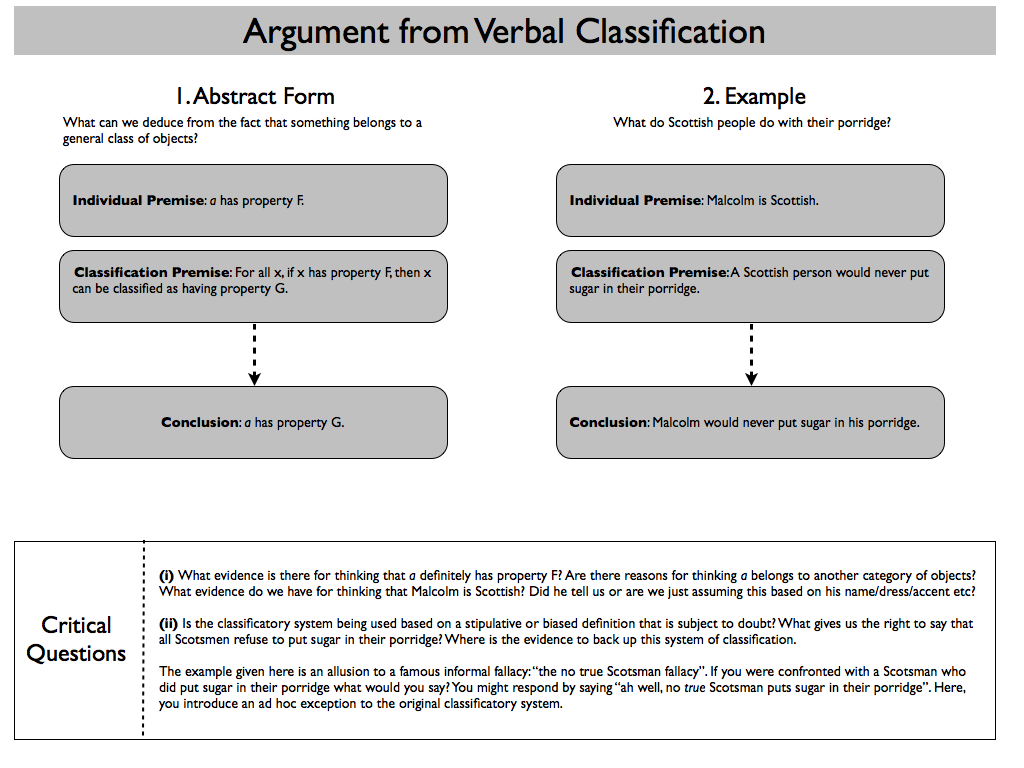
Here are the remaining argumentation schemes following on from the previous post.
More to chew over here.
8. Argument from Sign
9. Argument from Commitment
10. Argument from Inconsistent Commitment
11. Direct Ad Hominem Argument
12. Circumstantial Ad Hominem
13. Argument from Verbal Classification
Showing posts with label Philosophy 101. Show all posts
Wednesday, March 31, 2010
Tuesday, March 30, 2010
Argumentation Schemes (Part 1)
I don't know if anybody is interested in this kind of thing, but in case they are the following is based on a set of handouts I once prepared on argumentation schemes. It is based on work by the argumentation theorist Douglas Walton (taken specifically from this book). He has literally written the book on every informal fallacy out there, worth checking out.
The argumentation schemes here are what Walton calls "common presumptive arguments". A presumptive argument is, according to Walton, not based on deductive nor inductive principles. Instead, it is based on defeasible presumptions. They are far more common in argument than we might care to think, so familiarity with them is essential.
Each image provides the abstract form of the argument, an example and a set of critical questions.
1. Argument from the Position to Know
2. Appeal to Expert Opinion
3. Appeal to Popular Opinion
4. Argument from Analogy
5. Argument from Correlation to Cause
6. Argument from Positive/Negative Consequences
7. The Slippery Slope Argument
The argumentation schemes here are what Walton calls "common presumptive arguments". A presumptive argument is, according to Walton, not based on deductive nor inductive principles. Instead, it is based on defeasible presumptions. They are far more common in argument than we might care to think, so familiarity with them is essential.
Each image provides the abstract form of the argument, an example and a set of critical questions.
1. Argument from the Position to Know
2. Appeal to Expert Opinion
3. Appeal to Popular Opinion
4. Argument from Analogy
5. Argument from Correlation to Cause
6. Argument from Positive/Negative Consequences
7. The Slippery Slope Argument
Wednesday, December 9, 2009
Philosophy 101
This is going to be a blog about philosophy. As such, it is appropriate to begin with a general philosophical framework. This framework will serve as a guide for all future posts.
I take philosophy to be concerned with asking questions about us and our relationship to the world (if indeed there is a world beyond us).
In particular, I take philosophy to be concerned with asking three types of questions.
1. Ontological Questions
Ontological questions are about the nature of existence. What kinds of things exist? How do they work? How did they get here? What will things be like in the future?
2. Ethical Questions
Ethical questions are about conduct. What kinds of activities should I engage in if I want to live a meaningful and fulfilling life? And how should I treat other people?
3. Epistemological Questions
Epistemological questions are concerned with the nature of knowledge. It is easy to make claims about the nature of existence or the nature of ethics, but which claims are true and which are false? We need to have some sort of quality control. Epistemology attempts to establish this quality control by developing appropriate methods of inquiry.
This framework is illustrated below (click to embiggen).
In future posts I will be exploring these philosophical questions in many different domains. For the most part, this will take the form of reference guides and summaries of the work of others. However, I will occasionally present some original analyses.

Subscribe to:
Posts (Atom)