Search This Blog

Showing posts with label googlers and culture. Show all posts

Friday, September 2, 2011

Navigating a proposal with Google Maps for mobile

I recently decided to propose to my girlfriend, Faigy. I knew I wanted to do something meaningful and —yes—a little over the top, so I decided to put my software engineering skills to work to create the ultimate romantic scavenger hunt. On the road to “The Big Question,” I wanted Faigy to visit places around New York City that were filled with memories of our relationship. My plan was to construct a map of the route and get my girlfriend from one destination to the next, all with the element of surprise. Google Maps gave me the tools I needed to make the magic happen.


View Faigy & Ari's Engagement Route in a larger map

I used My Maps to plan out the route—from the Trader Joe’s we shop at on the Upper West Side, to Magnolia Bakery where we spent part of our first date, to Hudson Bar & Lounge where we enjoyed a night of dancing, to Carnegie Hall where Faigy once surprised me with tickets to a Beethoven concert, all the way to the lighthouse on Roosevelt Island where we went on our second date.

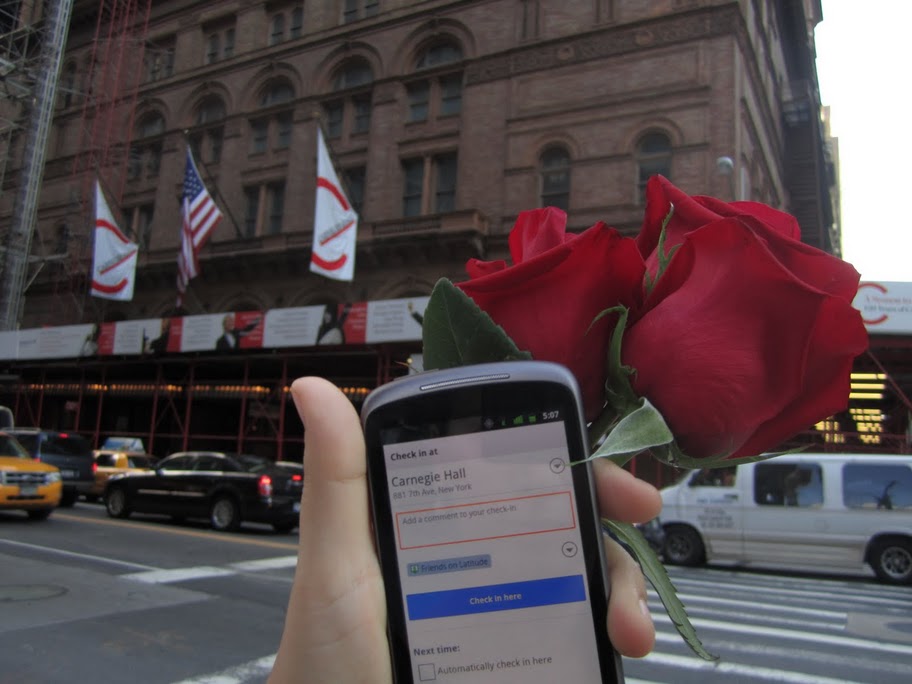
I secretly coordinated with Faigy’s manager at work to give her a Nexus One preloaded with Google Maps for mobile, a camera and instructions to go to the first location. I had a friend stationed at each of the six locations before the final stop to give Faigy a rose, take a picture of her with the roses and make sure she checked in with Google Maps. Meanwhile, I anxiously awaited her arrival at the Roosevelt Island lighthouse.


Her phone had a custom mobile app I’d built (with the help of my fellow Google engineers Andrew Oplinger and Matt Keoshkerian). The app would let Faigy check in to each location, then prompt her for a password to find out the next location. I provided each friend with a question to ask Faigy, tied to our memories of that particular place, the answer to which was the password. When Faigy entered the password, the app would automatically initiate walking navigation to the next location.


When she got to the checkered pin that marked her last destination, her seventh and final rose also came with a question—but this one was from me, and it wasn’t any ordinary question. I’ll leave it to you to guess what her answer was!


Posted by Ari Gilder, Software Engineer

Wednesday, August 31, 2011

Taking cars off the road with our transportation programs

This is the third in a short series of posts and videos spotlighting our efforts to make Google greener. In this post, we give you a glimpse at how our transportation programs help Googlers get to work while leaving their cars at home. -Ed.

Commuting to work without driving, meeting with someone on another continent without flying and riding cars without gasoline? It’s not a futuristic dream, but a way of life at Google. We support and encourage carbon-free commuting because it’s a vital part of our longstanding commitment to sustainability.

We help take cars off of the road—not quite like the Hulk, but we are green. Back in 2004, one motivated Googler started a vanpool that ran from San Francisco to Mountain View as a 20 percent project. As demand grew, the program morphed into what is now one of the largest corporate shuttle services in the country. Today, up to a third of employees ride the GBus shuttles throughout our Bay Area offices five days a week—that’s more than 3,500 daily riders, or 7,000 one-way car trips avoided each day.


Beyond the convenience and comfort that our shuttle rides offer—of which I’m reminded during my daily 35-mile commute from Alameda to Mountain View—they’re also environmentally friendly. Our shuttles have the cleanest diesel engines ever built and run on 5 percent bio-diesel, so they’re partly powered by renewable resources that help reduce our carbon footprint. In fact, we’re the first and largest company with a corporate transportation fleet using engines that meet the Environmental Protection Agency’s 2010 emission standards.

Not only do we encourage self-powered commuting, we reward it. Googlers earn credits each time they get to work via alternative (non-engine) means—by bike, foot, skateboard or kayak. These credits are then translated into a dollar amount that gets donated—$100 for every 20 days of participation—to the Googler’s charity of choice. This year, 56 offices also participated in “Bike to Work Day,” with more than 2,500 Googlers who biked to work worldwide. The annual celebration is meant to reward daily cyclists as well as introduce many new riders to biking.

The green life doesn’t stop once Googlers get to work. In Mountain View, our GBike system distributes about 1,000 bikes across the campus that Googlers can pick up whenever they have to get to another building. For longer distances and off-campus trips, we have the GFleet, our electric vehicle car share program, and our on-campus taxi service GRide. We're also installing hundreds of electric vehicle charging stations throughout several of our offices, making it easy for Googlers to charge up their own electric cars for free at work. If Googlers need to chat with their colleagues in other cities or continents they can use video conferencing technology, which cuts down on potential air travel.

In total, the combination of the GFleet and our shuttles result in net annual savings of more than 5,400 metric tons of CO2. That's like taking over 2,000 cars off the road every day, or avoiding 14 million vehicle miles every year. With the help of Googlers, we’ll continue powering the wheels of sustainable transit innovation.

Thursday, August 25, 2011

Food for (green) thought

This is the second in a short series of posts and videos spotlighting our efforts to make Google greener. In this post, we give you a glimpse at our sustainable food programs. -Ed.

When it comes to eating sustainably, it’s about more than being organic, grass-fed or cage-free. Through our food program, we delight and support Googlers as well as uphold our company’s health and environmental values. And it’s a job we relish, because food is such a defining part of our unique culture. Our cafes and microkitchens help spark greater innovation and collaboration, allowing different teams to come together to share ideas, problem-solve or just get to know each other better over lunch or a mid-morning snack.

As part of Google’s Food Team, we serve roughly 50,000 healthy and delicious meals every day at nearly 100 cafes around the world—and strive to apply sustainable food principles to all the cafes we operate. We aim to source food that’s as local, seasonal and organic as possible. This helps us prevent artificial additives, pesticides and hormones from entering Google’s food supply—whether that means sourcing our eggs from cage-free chickens or using steroid- and antibiotic-free poultry. It’s fresher, and it tastes better!


Through Google’s Green Seafood Policy, we’ve established guidelines to help ensure that (whenever and wherever possible) we purchase species caught locally from independently managed fisheries that use environmentally responsible catch practices. At our Mountain View headquarters, where we benefit from our proximity to the ocean and local agriculture, we’ve been able to establish close relationships with several local, independent farmers and fishermen. We see firsthand how they raise and harvest their stock, and what sustainable catch methods they use. Much of our Mountain View produce (nearly half of which is organic) comes from farms in California, and our seafood comes from within 200 miles. Many of our campuses also have edible gardens that empower green-thumbed Googlers to grow herbs for their own cooking.

Because optimal eating habits extend beyond the walls of our offices, we’re committed to helping Googlers make the most informed choices possible as part of a healthy lifestyle. We want to not only become the healthiest workforce, but also make it easier for employees to take Google’s sustainable food values home to share with friends and family. Many of our offices in the U.S. offer Community Supported Agriculture (CSA) programs where Googlers can buy fresh, seasonal produce directly from local farms that’s delivered right to campus. In Mountain View, we also recently launched the Google Green Grocer program, where Googlers can order the same high-quality, sustainably sourced seafood, meat and eggs they already enjoy in our cafes, while supporting local community fisheries and farms.

We also pay very close attention to how we manage and reduce waste from our food program. Most employees use non-disposable dishware, and all of our grab-and-go containers are compostable. We have recycling and composting bins throughout many of our offices worldwide, and 20 percent of food waste from our cafes is recycled. In fact, organic food waste from our cafes in Europe, the Middle East and Africa is recycled to help produce bio-diesel or electricity. In some of our U.S. offices, any untouched, edible food is donated to local shelters, and the rest is put to use as compost.

Through our our cafes, microkitchens, edible gardens and community-supported food programs, we’re connecting Googlers to sustainable values on a daily basis. The more we care about what happens to the food on our plates and where it comes from, the more it can improve our health, our local economies and the environment.

Friday, July 29, 2011

Gone fishin’—piloting community supported fisheries at Google

(Cross-posted on the Google Green Blog)

I've always loved the ocean—I was born in Shanghai, which means "upon the sea.” And as a chef, I'm always drawn to food that claims a spirit of place. After moving to California, near Half Moon Bay, I began visiting the docks to buy seafood, and got to know the fishermen.

Over time, it became evident to me that this part of our food supply is broken: many consumers purchase stale, unsustainably-raised fish from chain grocers. Meanwhile, fishermen often sell their diminishing catch to wholesalers at a very low profit, meaning their livelihoods are no longer sustained by their catch. There’s also the environmental factor to consider: Overfishing and illegal practices cause worldwide decline in ocean wildlife populations and wreak havoc on underwater habitats—not to mention the carbon footprint of transporting seafood far from its origin.

Google’s chefs have long been committed to sourcing food for our cafes as locally, seasonally and organically as possible. And in our Mountain View headquarters, many employees cook with the same ingredients at home thanks to on-site Community Supported Agriculture (CSA) programs. When I joined the team as an executive chef in Mountain View, I wanted to make a difference in our purchasing program for seafood. For the five years leading up to then, I wrote a column for the San Francisco Chronicle called “Seafood by the Season,” and I knew it could be done. In early 2010, we began a push to apply the most rigorous standards to our seafood-buying practices, and respond to the in-the-moment fluctuations of the catch from small, independent fishermen.

Things took off from there. My colleague Quentin Topping dreamed of providing the same high-quality seafood we serve in our cafes for Googlers to take home to their families. That idea became the Google Community Supported Fishery (CSF), which we launched in May 2011. In this program, Googlers sign up to purchase a weekly supply of local, sustainable seafood, supplied through a partnership with the Half Moon Bay (HMB) Fisherman’s Association.


The Google Culinary team on a visit with fishermen in Half Moon Bay, Calif.—Quentin and I are the second and third from the left, in black.

We tend to think on a massive scale at Google—whether it’s how to deliver instant search results around the globe or help thousands of small businesses get online—but when it comes to feeding our employees at work and at home, it really comes down to a local touch. Knowing where our seafood, meat and produce come from, as well as knowing how they’re raised, farmed or harvested, makes all the difference in the on-the-ground work of sustainability. We see many bright spots ahead for our Community Supported Agriculture and Fishery programs, such as expansion to other offices and adding a grass-fed beef and pasture-raised poultry program. It’s exciting to work someplace where we can think big and local.

We know of two CSFs in the Bay Area. The Half Moon Bay Fishermen’s Association supplies only Google at the moment, but will soon add public drop-off sites—keep posted by visiting Farmigo.com. The other is CSea out of Bodega Bay. If you live elsewhere, we hope you’ll consider stepping up to create one in your area.

And even if you don’t live near the ocean or have direct access to fresh-caught seafood, the choices you make about what fish to purchase or order in restaurants can make a real difference. You may want to consider following the guidelines that we used for our Google Green Seafood policy: Whenever possible, purchase species caught locally and in-season, by small, independent fisher-families, using environmentally-responsible methods. We think it’s important to be responsive to the fluctuations of catch too, and source from fisheries that enforce catch limits or are guided by ecosystem-based management programs. As for us, we’ll continue to research and source responsibly managed farmed seafood, and always keep transparency and Googler health at the center of our program.


Wednesday, July 27, 2011

Congratulations Russia, the National Geographic World Champions

(Cross-posted from the Lat Long and Student Blogs)

This island has a population of about 57,000 people, with the most settlements concentrated on the west coast. Very little of this island is suitable for agriculture.

After eight rounds of questions from none other than quiz king Alex Trebek himself, the team from Russia was crowned the National Geographic World Champions today at our Mountain View, Calif. headquarters after answering this final question correctly.

(By the way, the answer is Greenland.)


The National Geographic World Champions from Russia (photo courtesy of National Geographic)

Students from 17 regions around the world competed in the 2011 National Geographic World Championship. Today’s final round included answering a series of challenging questions like the one above. The students also interpreted maps and museum artifacts from the University of California Berkeley and fielded questions about live animals from the San Francisco Zoo during the earlier rounds of the competition.

Congratulations to the Russian team and to all of the students who participated. We look forward to seeing where your explorations and knowledge take you.

Thursday, June 30, 2011

GoogleServe 2011: Giving back around the world

Over the last month, more than 7,700 Googlers helped serve their communities across 400 different projects as part of GoogleServe, an employee-driven initiative organized almost entirely by volunteers. Through partnerships with nonprofits, schools and local governments, Googlers from 119 cities in 36 countries helped communities in need with projects ranging from educating youth about online bullying to cleaning up local rivers and parks.

GoogleServe began in 2008 and has become an annual company tradition. Giving back to our communities not only revitalizes and strengthens our connections with the cities and towns in which we live and work, it also brings us closer together as a global team. Each year the event has grown in size and scope and this year’s GoogleServe was our largest yet. Here’s a sampling of some of the projects we participated in this time around:
While GoogleServe is an annual celebration of community service, employees donate both time and money to organizations and causes throughout the year. You can find opportunities to serve your local community at All For Good.

Here are some photos of our team in action:


Tuesday, June 28, 2011

Celebrating Pride 2011

More than a thousand Googlers participated in Pride celebrations in a dozen cities to support equality and remember the sacrifices of those who have made life better for members of the LGBT* community today. While we celebrated the legalization of marriage equality in New York, the state where the gay rights movement in the United States began more than 40 years ago, our participation was especially global this year: we were at Mardi Gras in Sydney, Australia for the first time and supported Pink Dot in Singapore. From San Francisco to Dublin to Tel Aviv to Boston, we stepped out in large numbers for Pride parades around the world in a colorful swirl of Gaygler and Android Pride t-shirts. As in years past, we featured a month-long easter egg in our search results worldwide to celebrate Pride, adding a rainbow next to the search box for a number of Pride-related queries including [lgbt], [marriage equality] and [pride 2011].

But it’s not just during Pride week that we celebrate and promote equality and diversity. We’ve partnered with various organizations and earlier this year employees contributed their stories to the It Gets Better project.

In addition to our external efforts, we’re also working from within. Recently, we extended domestic partner benefits in regions such as China and Hong Kong. Last year, Google adopted a policy promoting benefits equality through a gross-up on imputed taxes for health insurance. We provided the equivalent of the Family and Medical Leave Act for same-sex domestic partners and updated the definition of infertility. Happily, over the last year we’ve been approached by many organizations looking to do the same.

Gayglers around the globe created this video to increase awareness about the LGBT community at Google, and we're happy to share it with you today.


Posted by Cynthia Yeung, Strategic Partner Development Team

*LGBT stands for lesbian, gay, bisexual or transgender but, without letting the acronym get too unwieldy, is also intended to include people who identify as queer, asexual or intersex, amongst others.

Thursday, June 9, 2011

Leading the charge toward an electric vehicle fleet

(Cross-posted on the Green Blog)

Over the last few years, several innovative electric vehicle (EV) technologies have emerged in the marketplace and we’ve been working to update our green transportation infrastructure. As a result, we’ve now developed the largest corporate EV charging infrastructure in the country. We’re also including the next generation of plug-in vehicles in Gfleet, our car-sharing program for Googlers.

When Google.org launched the RechargeIt initiative in 2007, there were no commercially available plug-in hybrid EVs on the market. So we bought several Toyota Priuses and had them retrofitted with A123 Hymotion batteries to create our own mini-fleet of plug-in hybrids to demonstrate the technology. It was the birth of Gfleet, which has since become a valued perk and makes it easier for Googlers to use our biodiesel shuttle system to commute to work by providing green transportation options for people after they arrive at the Googleplex. The new Gfleet will include more than 30 plug-ins, starting with Chevrolet Volts and Nissan LEAFs, several of which have already arrived and are available for Googlers to use today. We’ll be adding models from other manufacturers as they become available.

To juice up our new cars and provide more charging options for Googlers, we’ve been working with Coulomb Technologies’ ChargePoint® Network to continue to expand our EV charging infrastructure. We’ve added 71 new and faster Level 2 chargers to the 150 Level 1 chargers we’ve installed over the last few years, bringing our total capacity to more than 200 chargers, with another 250 new ones on the way. The ChargePoint Network provides us the charging data necessary to track and report on the success of our green transportation initiative.

Overall, our goal is to electrify five percent of our parking spaces—all over campus and free of charge (pun intended) to Googlers. Our expanded charging system has already helped several Googlers decide to buy new EVs of their own, and we hope others will, too.


All told, Gfleet and our biodiesel shuttle system result in net annual savings of more than 5,400 tonnes of CO2. That’s like taking over 2,000 cars off the road, or avoiding 14 million vehicle miles every year! But we’re only one company, so we hope other companies think about how they can incorporate these new technologies into their own infrastructure. By supporting new, green transportation technologies, we’re enabling our employees to be green and doing our part to help spur growth in the industry.

Friday, May 20, 2011

Japan Prize honors Googler Ken Thompson for early work on UNIX

This week, our own Distinguished Engineer Ken Thompson was awarded the Japan Prize, one of the most prestigious prizes in science, in the category of Information and Communications. Established in 1985, the Japan Prize is awarded annually to esteemed scientists around the world for outstanding achievement in the field of science and technology that also aids in the advancement of peace and prosperity.

Ken shares the prize along with his former collaborator, Dennis Ritchie, for their development of the operating system UNIX. They both worked at Bell Labs in 1969, when they began developing an open source operating system that emphasized portability, small modules and superior design. UNIX served as a core infrastructure element in the information field, including the Internet, and operating systems carrying on the UNIX philosophy are now being used everywhere from mobile phones to supercomputers. As Foundation Chair Hiroyuki Yoshikawa noted, UNIX has been “a major driving force behind the development of the information age” with clear overarching benefits to society.

Traditionally, the Japan Prize is awarded during a week-long celebration in Tokyo—even their Majesties, the Emperor and Empress of Japan, participate. Given the devastating earthquake and tsunami in Japan two months ago, the Foundation understandably concluded that the ceremonies should not be held this year. However, the Emperor insisted that the Foundation should travel to the U.S. to present the award to Ken and Dennis.

At the May 17 ceremony at the Googleplex, Ken received his recognition in front of a packed room of appreciative Googlers. The Foundation also recognized our crisis response team for their Person Finder project among other contributions, which helped Japanese citizens trying to locate lost friends and family after the March devastation.

From left to right: Vint Cerf, Ken Thompson, Hiroyuki Yoshikawa

In a short video about Ken and Dennis shown during the ceremony, Ken made this observation: “Research and development are two different things. Development has clear goals, but research is goal-less because it is the act of discovering something new. My advice to researchers is to continue enjoying the research at hand....UNIX resulted from research into new things we were merely interested in. We were very lucky it turned out to be very fruitful.”

In his acceptance remarks, Ken told one of the funniest stories I have ever heard about a pet alligator that he brought to Bell Labs and that later got loose. It is on the recording of the ceremonies—watch it here. Congratulations again to Ken and all the other Japan Prize winners and here’s to continued innovation in science and technology that fosters peace and prosperity around the world.

Join us at Maker Faire

(Cross-posted on the SketchUp Blog)

Creativity at Google isn’t just limited to the time we spend in front of our keyboards—many of us are also enthusiastic about making things with our hands. At our Google Workshops, for example, employees have the chance to use sophisticated tools and machines to physically prototype their ideas. The Street View trike and several components of our self-driving cars were built in these workshops. It’s also not unheard of for Googlers to build their own zip-lines, perform crazy experiments with giant lenses and just get plain silly.

This weekend, we hope to bring this spirit of creativity and experimentation to attendees of Maker Faire Bay Area, whose mission is to "celebrate arts, crafts, engineering, science projects and the Do-It-Yourself (DIY) mindset.”

Our own Maker Faire theme is simple: “Dream, design, build. Repeat.” At the event, we’ll demonstrate how Google technologies, like SketchUp and the Android Accessory Development Kit (ADK), can help you take your project from idea to object.

Design of our booth made in SketchUp

In keeping with the DIY vibe, our booth was constructed three full-size recycled shipping containers and outfitted with big screen TVs, 3D printers, CNC cutters and, most importantly—robots! Folks from the Google SketchUp team and the newly-formed Cloud Robotics team will be on hand to walk you through the steps of of designing, fabricating, building and programming your own robot.
SKPR Bot

Our booth will also have demos, games, giveaways, hands-on activities for both kids and adults and talks from folks like MAKE Editor-in-Chief Mark Frauenfelder. And to top it off, we'll open Maker Faire each morning with an Android-powered weather balloon launch at 10:00 am PDT (weather permitting).

See our Google at Maker Faire site for a full schedule of Google events, and make sure to follow @sketchup on Twitter for updates throughout the weekend.

Fellow Makers—we hope to see you there!

Friday, May 6, 2011

Google moms share tech tips for your family

As a Googler I often take my work home with me—in a good way. With two young boys at home, life is always busy, so my husband and I are always looking for ways to save time, get organized and enrich our lives in simple ways. Because the products I beta test and use in the office have become an integral part of my own family life, for Mother’s Day this weekend I’d like to share some favorite tips, including a few from other Googler parents.

Capturing and sharing memories
  • Instead of keeping 500 crayon masterpieces, store digital photos of all your kids’ artwork in Picasa Web Albums
  • Collect trip or party photos in one place by letting all of your paparazzi upload their snapshots to a collaborative online album
  • Tag friends and family in Picasa photos so you can easily create and share personalized collages, gift CDs/DVDs or movie slideshows
  • Use Picnik to edit your Picasa Web Albums photos. Use the “Create” tab to add text, stickers, frames and other effects to your photos—your kids can help, and you can email them as digital cards to distant relatives
  • Safely share home videos with family by inviting them to view a private YouTube video
  • Keep a running family history by encouraging relatives around the world to contribute stories and biographies in a shared Google doc or blog
Communicating and entertaining
  • Video chat through Gmail for free with long-distance grandparents and friends—this is also great for connecting kids with their parents when traveling
  • Entertain kids on the run with kid-friendly YouTube channels—like Sesame Street and School House Rock—Android apps or your own photos and videos on your mobile phone (kids love watching themselves!)
  • Have your kids help you create a video card or a cartoon on YouTube
  • Explore the world from the couch—fly around Google Earth on your mobile phone or tablet
  • On camping trips, use Sky Map to explore and name constellations. You can even travel back in time to show your kids what the sky looked like on the day they were born
  • Read the classics—like Anne of Green Gables, The Wind in the Willows and Grimm’s Fairy Tales—for free from Google eBooks; for older kids, many books that are required reading for school are also free. Google eBooks are accessible and readable on devices your family probably already has—like laptops or smartphones
My son Kai chatting with his dad while on a business trip

Organizing and planning
I hope these tips inspire moms (and dads) to celebrate your family this weekend. Here’s hoping you can save time and energy to focus on having fun with your kids!

Friday, April 22, 2011

Celebrating Earth Day

Today, we’re celebrating Earth Day with an animated, interactive doodle on our homepage and events at Google offices around the world. At our headquarters in Mountain View, Calif., we’re holding an environmental fair for Googlers, complete with speakers and contests to strengthen Googlers’ green acumen, and a cookout using—what else—parabolic solar cookers (don’t worry, we’ll compost the leftovers).

Our campus garden in Mountain View

We’ve been carbon neutral since 2007 and—Earth Day or not—we’re always asking ourselves what we can do to make the world greener today than it was yesterday. This week, we launched a new website with many of the questions we’ve been asking over the years that have inspired our environmental initiatives. What can we do to make renewable energy cheaper than coal? How can we run a data center using 50 percent less energy? And what does it take to green our energy supply?

It’s questions like these that led us to install solar panels on our Mountain View campus in 2007—at the time, the largest corporate solar installation in the U.S. They’re also what made us decide to donate to Googlers’ favorite charities based on how often they self-power their commute, whether by bike or by pogo stick. We hope the new website helps you start asking bold questions that lead to innovative solutions to make the world a greener place.

In addition to our new site, we’ve had a busy few weeks continuing our green streak. We doubled down on greening our energy supply with our second power purchase agreement (PPA) in less than a year and made several new investments: at a solar photovoltaic plant in Germany (our first in Europe), and others in the largest wind farm and solar project in the world, bringing our total invested in clean energy to more than $350 million. While the investments won’t supply our operations with energy, we believe they make business sense and will spur development and deployment of compelling clean energy technologies.

This Earth Day, we’ll continue to ask ourselves what else we can do to bring us closer to true sustainability. We hope that you, and companies across the world, will be doing the same.

Monday, March 21, 2011

1000 @Google Talks videos now on YouTube

Last week, the @Google Talks team uploaded its 1000th video to YouTube. If you’re not familiar with this series, we host talks by authors and commentators at Google, and post videos of their readings and talks on a dedicated YouTube channel.

Authors@Google began in the fall of 2005 when we noticed that some amazing people were passing through the Google hallways. A few scrappy Googlers galvanized to create a more consistent pipeline of requests and a formalized program that kicked off with Malcolm Gladwell and James Surowiecki. As Google and our technology grew, so did the program. “Authors@Google” has blossomed into @Google Talks, a full-fledged speaker series, expanded across distributed offices and found a home on YouTube, so that we can share these conversations outside of the Googleplex.

The @Google Talks series aims to capture the popular and intellectual zeitgeist, as well as ideas that deserve a deeper focus an expert can provide in more than a five-minute soundbite. From the 2008 U.S. presidential candidates to Alice Walker to Michael Pollan to Raphael Saadiq, the program has grown to encompass not just authors, but musicians, innovators, notable women, chefs and more. The team that hosts these events is made up of dedicated and passionate volunteers from all across the company.

Our most viral video was of Conan O'Brien, who stopped by during his "Legally Prohibited from Being Funny on Television" tour for a hilarious hour involving bagpipes, Andy Richter and one lucky Googler who got to touch his hair. We've featured master and apprentice—from Thomas Keller of The French Laundry to Keller protege Corey Lee on the process of opening his new restaurant Benu—and varying viewpoints, exemplified by Christopher Hitchens on "God Is Not Great" and Tim Keller on "The Reason for God." And that’s just the beginning. Other popular visitors include Congressman Ron Paul, President Barack Obama, linguist and philosopher Noam Chomsky, presentation designer Garr Reynolds, author Elizabeth Gilbert, Randall Munroe of XKCD and U.S. Secretary of State Hillary Clinton.

We’re excited for what lies ahead, and we hope you'll tune in and join us.

Friday, March 18, 2011

National Engineers Week 2011: Classroom visits inspire students to pursue CS

We love using our computer science (CS) and engineering skills to solve some of world’s most interesting and important problems. We also know that not enough students are pursuing careers in CS and that the U.S. currently has a 3-to-1 gap for computer and mathematical sciences jobs (that’s three job openings for every job seeker). So this year, for National Engineers Week, Google engineers across the country visited local middle schools and high schools to talk to more than 5,000 students about their own careers in computer science.

Instead of hosting students at Google for National Engineers Week as we’ve done in the past, this year we traveled to local communities to talk to the students on their own turf. Engineers Week fell during spring break in many areas, so we spread our school visits throughout the month of March.

As part of this event, I visited Odle Middle School in Bellevue, Washington with four other engineers from our Kirkland office. We split up into 16 different classrooms during the day, and talked about the importance of basic programming skills for all the sciences (it’s not just for CS majors!) before moving on to activities related to programming and algorithmic thinking (searching and sorting). It was a lot of fun to interact with the students—and we all left with a greater appreciation for the work that the teachers perform every day.

One of the engineers in our group is Japanese (his friends and family are fortunately all safe) and he gave a particularly resonant example of how CS can have a big impact. After the recent earthquake, geologists used computer models to predict where and when tsunamis were likely to hit coastal regions. This information was used to send warnings and direct resources where they were needed most. The speed and accuracy of these warnings is a credit to the scientists who combined their knowledge of geology with their programming expertise to produce these life-saving programs.

We really care about encouraging students to pursue careers in all the sciences (including computer science). By introducing students to interesting people who work in computer science, we hope we can inspire them to develop their own skills in this area.

Monday, March 7, 2011

100 years of celebrating women

(Cross-posted on the LatLong Blog)

As today’s doodle shows, we’re very excited to celebrate the centenary of International Women’s Day. Late last month we teamed up with Women for Women International to announce the Join me on the Bridge campaign, a celebration of the achievements of women taking place on bridges around the world. Since then almost 300 bridge events in more than 50 countries have been added to the map. I’ve found it inspiring to watch all of those little red pins pop up, knowing that each of them represents a group of women and their supporters coming together to let the world know how far we’ve come.


In addition to the flagship events happening throughout the day on the Brooklyn Bridge (New York), the Millennium Bridge (London) and the Golden Gate Bridge (San Francisco), women and men are gathering in places as far-flung as Kabul, Afghanistan, La Paz, Bolivia and Sydney, Australia.

It’s not too late to join the celebrations and show your support—simply find an event on the map. Remember to “check in” to the event on the map before the end of the day, and if you have photos or videos of an event, it’s easy to share them with the world: just click on the pin for the event you attended (or want to support virtually) and start uploading.

We hope you’ll also consider donating to one of the more than 40 incredible women’s organizations participating in our celebration. You can learn more and make a donation at google.com/iwd2011.

Plus, when you use Google Maps on March 8, you’ll notice that Pegman, Street View’s trusted guide, has a new friend. He invited his colleague Pegwoman to join him on the map today to celebrate International Women’s Day!

Friday, January 14, 2011

MLK Day 2011: a day for community service

“Life’s most persistent and urgent question is: What are you doing for others?”
- Dr. Martin Luther King, Jr.


Next Monday, January 17, marks the 25th anniversary of the Martin Luther King Jr. holiday. We join Americans in celebrating the life and legacy of Dr. King as a company-recognized holiday. You may not know that Martin Luther King Day is not only a federal holiday, but also a national day of service. In 1994, Congress passed the King Holiday and Service Act, which encourages citizens to volunteer on that day.

This MLK Day, many Google employees are participating in service projects from coast to coast. We’re also joining the Corporation for National & Community Service, a Google Grants recipient, to spread the word about volunteering opportunities around the country. On their MLKDay.gov site you can learn about the King Day of Service and find a project in your area. Projects include delivering meals, refurbishing schools and community centers, collecting food and clothing, signing up mentors, reading to children, promoting nonviolence and more. Many of these projects start on King Day and last throughout the year.

Together, let’s make Martin Luther King Jr. Day “a day on, not a day off.”

Wednesday, December 22, 2010

Investing in New York

Google New York started in a Starbucks on 86th Street with one person in 2000—a scrappy, highly-caffeinated sales “team.” After moving to a larger office in Times Square, in 2006 we relocated to our current home in Chelsea, at 111 Eighth Avenue—a former Port Authority building. In June of 2008, we took additional space in the Chelsea Market building at 75 Ninth Avenue. Now we have more than 2,000 Googlers working on a variety of projects in both sales and engineering—and we’re hiring across the board.

Today, we’re pleased to announce that we’ve closed a deal with the partnership of Taconic Investment Partners, Jamestown Properties and the New York State Common Retirement Fund to purchase 111 Eighth Avenue (also known as 76 Ninth Avenue). As part of the deal, we’ve retained Taconic Management Company to continue the leasing oversight services and management of the building on our behalf, providing the same level of customer service the building’s tenants have come to expect. We believe that this is a great real estate investment in a thriving neighborhood and a fantastic city.

Like the city, our New York office is a melting pot of cultures and ideas—it’s home to Googlers from more than 35 countries who speak more than 40 languages. They live in the five boroughs and spread across the tri-state area. We’re excited to continue to build our presence there.

Wednesday, December 8, 2010

It’s a beautiful day in this neighborhood: growing in Pittsburgh

Nearly five years ago, we announced that we would begin building an engineering presence in Pittsburgh, a city with a strong technology ecosystem as well as an entrepreneurial spirit and great quality of life. Since then, we’ve grown from two engineers to more than 150, and we’re continuing our commitment to growth in the region as we've officially opened a new Google Pittsburgh office in an old Nabisco factory in Bakery Square.

The Collaborative Innovation Center at Carnegie Mellon University had been our home since 2006, and our relationship with CMU remains invaluable to us. On top of the strong pipeline of brilliant engineers emerging from local universities, we’re seeing a “boomerang effect” of Pittsburghers who previously believed they had to go elsewhere to succeed with careers in computer science and engineering. We hope that the scrappy start-up culture we’ve maintained from the beginning at Google Pittsburgh as well as the burgeoning tech community throughout the city continues to encourage them to consider coming home.

In addition to teams focused on core initiatives related to Product Search and Ads Quality, we’re proud to be home to 20% time projects including the Sky Map planetarium app for Android phones, which combines astronomy, physics and computer science to put the galaxies in your pocket (and now includes the ability to time travel!) and Sky in Google Earth, which enables you to look upward from your position in Google Earth to view the heavenly objects above. Luis von Ahn and his reCAPTCHA team lead development of a technology that improves the process of converting scanned images into plain text, which powers initiatives like Google Books, and we welcome our first Enterprise sales leads who are working to help businesses and organizations in the region consider the benefits of cloud computing with Google Apps.


Our almost-40,000 square-foot space is Googley in many ways, but my favorite characteristics include a climbable trapeze net that extends from our second floor into thin air and a massive cookie-dough mixer preserved from the former Nabisco factory, which pays homage to Bakery Square’s manufacturing heritage.

If this sounds like the place for you, take a look at our open jobs and apply. We’re growing in Pittsburgh.

Thursday, November 11, 2010

Honoring Veterans Day 2010 at Google

Today is Veterans Day, the annual U.S. holiday honoring military veterans and the end of World War I, also celebrated as Armistice Day or Remembrance Day in other parts of the world. As we did last year, we want to recognize and thank these courageous men and women who willingly serve to defend the freedoms and rights of others.

For those of us who haven’t served, it’s also a day when we can seek to understand what it means to serve in the armed forces—in any country—and the burdens that military personnel and their families bear on our behalf.

This year, we celebrate the holiday with a special doodle on google.com—and YouTube is featuring content from veterans sharing their personal stories about life in combat and beyond. You’ll hear from Peter, who was awarded a Silver Star, the third-highest military decoration that can be awarded to a member of any branch of the U.S. armed forces for valor; Justin, a disabled veteran who is advocating for wounded warriors; and other brave men and women.

The Google Veterans Network, our employee group dedicated to veterans’ issues led 11 service projects in the U.S., U.K., Canada and Australia—bringing employees together with those who have served or are still serving. Nearly 200 Googlers volunteered approximately 500 hours in local communities like Ann Arbor, MI. and Seattle, WA. In Mountain View, we taught 510 students at Monta Loma Elementary School about the historic meaning of November 11 and service to one’s country. We also offered Veterans Day and Remembrance Day menus in our company cafes, including military paraphernalia displays and samples of MREs (meals ready to eat).

Through financial and in-kind support, the Google Veterans Network has worked closely with the Iraq and Afghanistan Veterans of America (IAVA), the Coming Home Project, Fisher House Foundation (Puget Sound), the Ann Arbor VA Hospital, The Royal British Legion and The Returned and Services League of Australia to make this November 11 a special one.

Friday, October 22, 2010

Working to stop bullying, National Ally Week and navigating online LGBTQ resources

We’ve all been saddened by the recent suicides of gay youth, especially as tragedy has piled atop tragedy. Each of them is a signal that we need to do more to put an end to these incidents that destroy the lives of both the children being bullied and children who bully.

We believe the Internet can provide a safe space and resources for youth who are struggling with their identity and looking for help. And we’ve been happy to see products like YouTube being used to deliver messages of hope. There are many organizations out there doing an extraordinary job providing resources for LGBTQ youth, and we wanted to highlight a few as part of GLSEN’s National Ally Week: Trevor Project, GroundSpark’s Respect for All Project, the YouTube “It Gets Better” project and the Gay Lesbian Straight Education Network. GLSEN’s Safe Space campaign page provides resources and support for educators, policy makers, community leaders and students to take action to make a positive difference. We recently made a $50,000 donation to the Trevor Project, in support of the Levi’s Challenge Grant announced on The Ellen DeGeneres Show—they will be matching up to $50,000 dollars in donations to the Trevor Project. We’ve also donated to GroundSpark and GLSEN. We hope that other companies and individuals will consider doing the same.

We also wanted to share a video some of our own Googlers made for the “It Gets Better” project documenting their own experiences and sending messages of encouragement to LGBTQ youth.


Finally, the Matthew Shepard Foundation has been in the forefront of LGBTQ issues educating the world and sharing the tragic story of Matthew Shepard. We asked Judy Shepard, Matthew’s mother, to share her thoughts with us on the recent tragedies and what we can do to help. Here’s what she said:
It’s been devastating lately to see so many families losing their LGBT kids to suicide and frankly, incredibly frustrating to see so many cases that seem to be linked in some way to bullying. My husband Dennis and I started the Matthew Shepard Foundation in the hope that by helping youth connect with resources, supportive allies and positive messages about their future, that it might prevent tragic outcomes like suicides or hate crimes. We’re just one part of a huge community of allies. And we are allies for all youth, whether they’re being singled out for their sexuality, or their race, or something else that makes them different. But if we can’t get the word out to the young people who really need to hear from us, and can’t make them more comfortable reaching out for help when they’re in crisis, then we’ll continue to struggle to protect them.

I’ve been out speaking at schools for the last 12 years to give these students a little hope and show them there are people they can turn to even if their own families aren’t accepting. I’ve also tried to open the eyes of the kids who are doing the bullying too—to show them the pain a victim’s family suffers. We lost a son, but the young men who killed Matthew are a sad example of how you can basically lose your life by victimizing people, too, almost as much as by being the victim.

-Judy Shepard
We honor the memory of Matthew and of the children who lost their lives this fall, and our hearts go out to their families. We thank Judy for her words and encourage everyone to work to help our youth to find safety and a better way to engage in the world—including using the Internet for the amazing good it brings, and not to bully others.

Related Posts Plugin for WordPress, Blogger...